
The False Dichotomy
"Should we fine-tune or use RAG?"
This question comes up in every AI project. The answer is almost never one or the other - it depends on your specific use case, constraints, and what you are trying to achieve.
After building both fine-tuned models and RAG systems in production, I have developed a framework for making this decision. This post shares that framework with real numbers from our deployments.
Understanding the Fundamentals
What Fine-Tuning Does
Fine-tuning modifies the model weights to learn new patterns:
| Aspect | What Happens |
|---|---|
| Knowledge | Baked into model weights |
| Style/Format | Learned from training examples |
| Updates | Requires retraining |
| Latency | Single model call |
| Cost | Training cost + inference cost |
What RAG Does
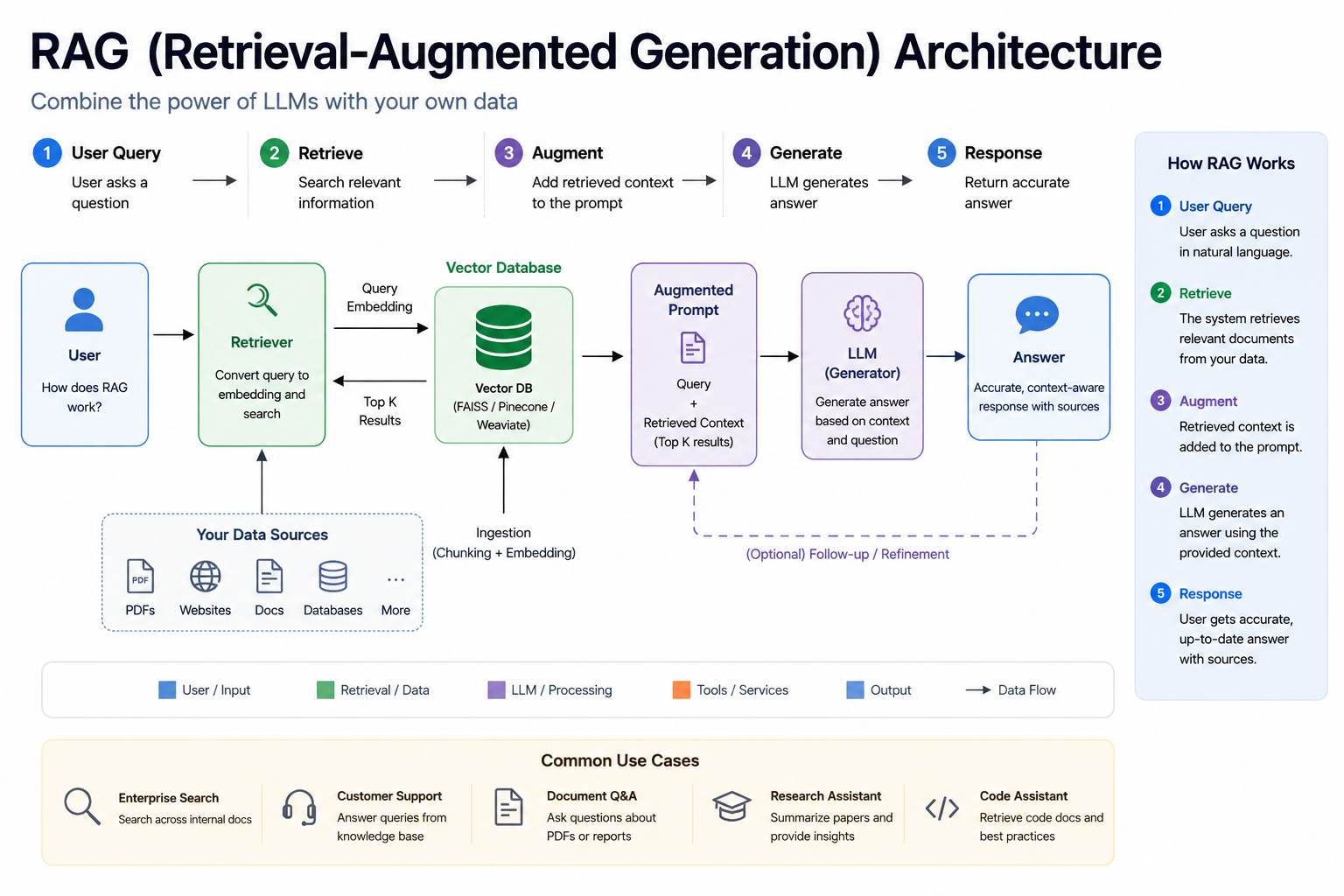
RAG retrieves relevant context and includes it in the prompt:
| Aspect | What Happens |
|---|---|
| Knowledge | Retrieved at inference time |
| Style/Format | Controlled via prompting |
| Updates | Update documents, instant effect |
| Latency | Retrieval + model call |
| Cost | Embedding + retrieval + inference |
The Decision Framework
Factor 1: Knowledge Dynamics
How often does your knowledge base change?
| Update Frequency | Recommendation | Why |
|---|---|---|
| Real-time (minutes) | RAG only | Cannot retrain that fast |
| Daily | RAG preferred | Training overhead too high |
| Weekly | Either works | Consider other factors |
| Monthly or less | Fine-tuning viable | Amortize training cost |
| Static | Fine-tuning preferred | Best latency and cost |
Factor 2: Knowledge Volume
How much knowledge needs to be accessible?
| Volume | Recommendation | Why |
|---|---|---|
| Small (< 100 docs) | Either works | Both handle well |
| Medium (100-10K docs) | RAG preferred | Hard to fit in fine-tune data |
| Large (10K-1M docs) | RAG required | Cannot fine-tune on this much |
| Massive (> 1M docs) | RAG with hierarchy | Need multi-stage retrieval |
Factor 3: Task Type
What are you trying to do?
| Task | Better Approach | Why |
|---|---|---|
| Q&A over documents | RAG | Need to cite sources |
| Style adaptation | Fine-tuning | Style is learned, not retrieved |
| Domain-specific language | Fine-tuning | Terminology in weights |
| Factual accuracy | RAG | Grounded in documents |
| Creative generation | Fine-tuning | Style matters more than facts |
| Code generation | Both | Fine-tune for style, RAG for docs |
Factor 4: Accuracy Requirements
How critical is accuracy?
| Requirement | Recommendation | Why |
|---|---|---|
| Must be verifiable | RAG | Can cite sources |
| Approximate OK | Either | Fine-tuning often sufficient |
| Domain expert level | Hybrid | Fine-tune + RAG together |
| Cannot hallucinate | RAG with guardrails | Verify against sources |
Cost Analysis: Real Numbers
Here is what we actually spend for different approaches:
Scenario: Customer Support Bot
Requirements:
- •50,000 queries per day
- •5,000 support articles
- •Articles updated weekly
- •Need to cite sources
| Approach | Monthly Cost | Accuracy | Latency |
|---|---|---|---|
| GPT-4 + RAG | $4,200 | 91% | 2.1s |
| Fine-tuned GPT-3.5 | $1,800 | 76% | 0.8s |
| Fine-tuned + RAG | $3,100 | 93% | 1.9s |
| GPT-3.5 + RAG | $1,100 | 84% | 1.4s |
Scenario: Legal Document Analysis
Requirements:
- •1,000 queries per day
- •50,000 legal documents
- •Must cite specific clauses
- •Cannot hallucinate
| Approach | Monthly Cost | Accuracy | Latency |
|---|---|---|---|
| GPT-4 + RAG | $890 | 94% | 3.2s |
| Claude + RAG | $920 | 96% | 2.8s |
| Fine-tuned + RAG | $1,400 | 97% | 2.4s |
Scenario: Code Documentation
Requirements:
- •20,000 queries per day
- •Internal codebase docs
- •Docs updated with each commit
- •Style should match company conventions
| Approach | Monthly Cost | Accuracy | Latency |
|---|---|---|---|
| RAG only | $2,100 | 82% | 1.8s |
| Fine-tuned only | $1,400 | 71% | 0.6s |
| Hybrid | $2,800 | 89% | 1.6s |
The Hybrid Approach
Often the best answer is both. Here is how we combine them:
Architecture
The hybrid approach uses a fine-tuned base model for style, tone, and domain understanding, while RAG provides current facts, citations, and specific details.
When Hybrid Works Best
| Scenario | Why Hybrid Wins |
|---|---|
| Domain-specific Q&A | Fine-tune for terminology, RAG for facts |
| Technical support | Fine-tune for troubleshooting patterns, RAG for specific solutions |
| Research assistance | Fine-tune for analytical style, RAG for papers/data |
| Code assistance | Fine-tune for coding style, RAG for documentation |
Hybrid Cost-Benefit
Our hybrid deployments showed:
| Metric | RAG Only | Fine-tuned Only | Hybrid |
|---|---|---|---|
| Accuracy | 84% | 76% | 91% |
| Latency | 1.8s | 0.6s | 1.6s |
| Monthly cost | $2,100 | $1,400 | $2,800 |
| User satisfaction | 4.1/5 | 3.6/5 | 4.5/5 |
Fine-Tuning: Practical Considerations
When Fine-Tuning Makes Sense
- 1Consistent output format - Train the model to always respond in a specific structure
- 2Domain terminology - Medical, legal, financial jargon
- 3Brand voice - Consistent tone and style
- 4Reducing prompt length - Behavior in weights instead of instructions
Fine-Tuning Costs
| Model | Training Cost (1M tokens) | Inference Premium |
|---|---|---|
| GPT-3.5 | $8 | 0% (same as base) |
| GPT-4 | $25 | 0% (same as base) |
| Llama 2 70B | $0 (self-hosted) | Infrastructure cost |
| Mistral | $0 (self-hosted) | Infrastructure cost |
Fine-Tuning Pitfalls
| Pitfall | Description | Mitigation |
|---|---|---|
| Overfitting | Model memorizes training data | More diverse examples |
| Catastrophic forgetting | Loses general capabilities | Careful learning rate |
| Data quality issues | Garbage in, garbage out | Curate training data |
| Evaluation difficulty | Hard to measure improvement | Hold-out test set |
RAG: Practical Considerations
When RAG Makes Sense
- 1Frequently changing information - Product catalogs, documentation, news
- 2Need for citations - Legal, medical, academic use cases
- 3Large knowledge bases - Too much to fit in fine-tuning data
- 4Multi-tenant systems - Different knowledge per customer
RAG Costs
| Component | Cost Per 1M Operations |
|---|---|
| Embeddings | $0.13 (text-embedding-3-small) |
| Vector DB queries | $0.02-0.10 (depends on provider) |
| LLM inference | Varies by model |
RAG Pitfalls
| Pitfall | Description | Mitigation |
|---|---|---|
| Retrieval failures | Wrong docs retrieved | Better chunking, hybrid search |
| Context window limits | Too much context | Summarization, reranking |
| Hallucination despite context | Model ignores context | Faithfulness evaluation |
| Latency | Multiple round trips | Caching, parallel retrieval |
Decision Tree
Here is our simplified decision process:
Start here:
- 1Does knowledge change daily or faster?
- 2Do you need to cite sources?
- 3Is knowledge volume > 10K documents?
- 4Is consistent style/format critical?
- 5Is this a creative or analytical task?
- 6Do you need both style AND current facts?
Key Takeaways
- 1RAG is the default choice for most knowledge-intensive applications. It is simpler to update, easier to debug, and provides citations.
- 2Fine-tuning is for behavior, not knowledge. Use it for style, format, and domain-specific language patterns.
- 3Hybrid often wins when you need both consistent behavior AND current, accurate information.
- 4Cost is not the only factor. Consider accuracy, latency, maintenance burden, and update frequency.
- 5Start with RAG, add fine-tuning if needed. It is easier to add fine-tuning to a working RAG system than vice versa.
- 6Measure everything. The right choice depends on your specific metrics - make decisions based on data, not assumptions.
The best approach is rarely obvious upfront. Build measurement into your system from day one so you can make data-driven decisions as you learn more about your use case.