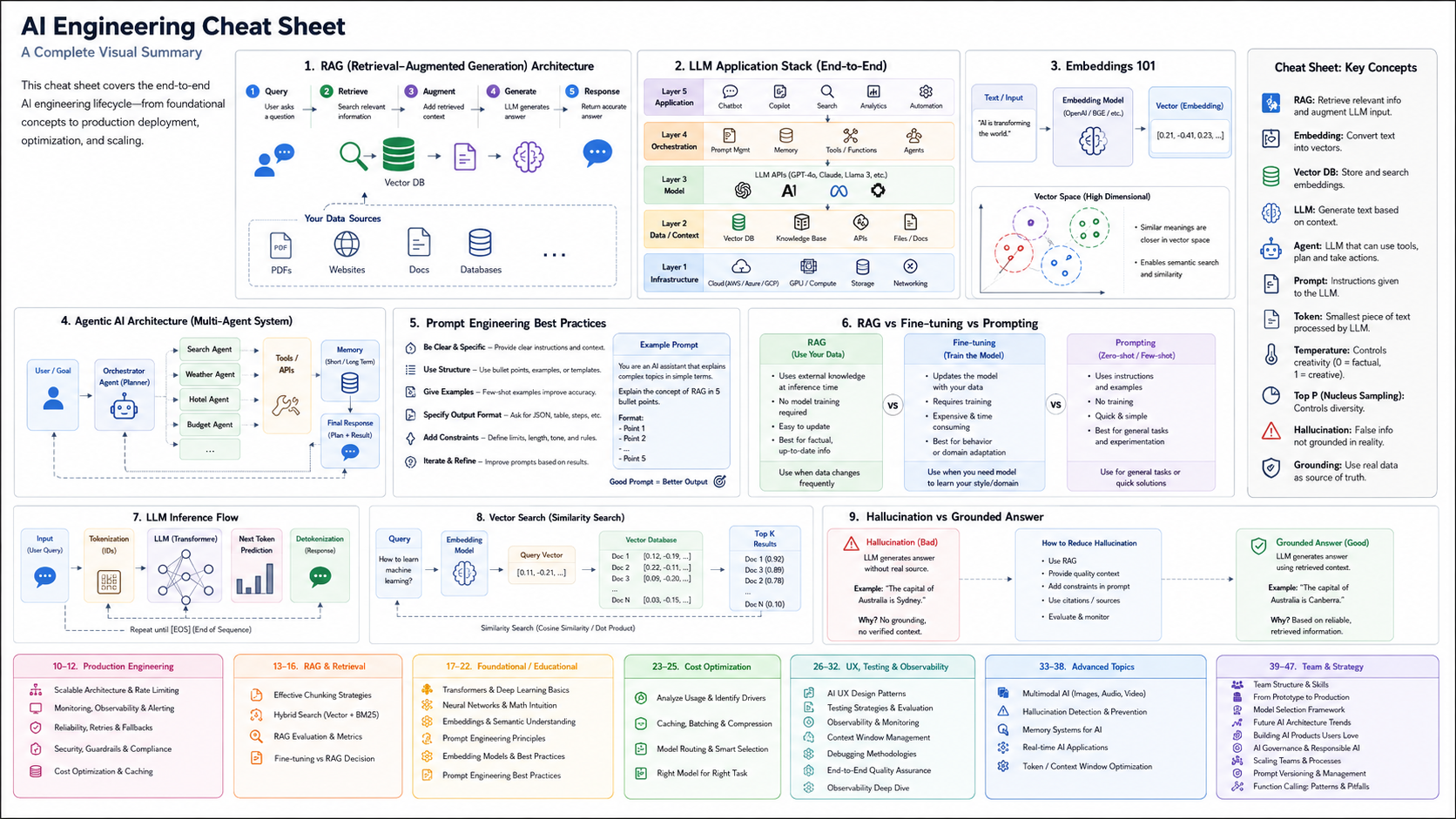

Why Prompting Matters
The same model can produce wildly different outputs depending on how you ask. A poor prompt gets mediocre results. A great prompt gets excellence.
Most people treat prompting as an art. It is actually a systematic discipline. This post documents the patterns and principles we use to write effective prompts.
Prompt Structure Fundamentals
The Basic Components
Every effective prompt has these elements:
| Component | Purpose | Example |
|---|---|---|
| Context | Set the scene | "You are an expert software architect" |
| Task | What to do | "Design a caching strategy for..." |
| Requirements | Constraints/format | "Keep it under 500 words" |
| Examples | Show the style | "Here is an example output:" |
The Template Approach
Do not wing it. Use a template:
Context: [Who are you? What expertise?]
Task: [What exactly do you need?]
Requirements: [Format, length, constraints]
Examples: [Show 1-2 examples of good output]
Current Request: [The actual query]
Template Impact
| Approach | Quality Score | Consistency |
|---|---|---|
| Unstructured | 6.2/10 | 40% |
| Basic structure | 7.4/10 | 65% |
| Full template | 8.6/10 | 92% |
Prompt Engineering Techniques
Technique 1: Chain-of-Thought
Make the model show its reasoning step-by-step.
| Without CoT | With CoT |
|---|---|
| "What is 7 × 8 × 2?" | "Let me work through this step by step: First, 7 × 8 = 56. Then 56 × 2 = 112." |
| Response: "112" | Response: "Step 1: 7 × 8 = 56. Step 2: 56 × 2 = 112. Answer: 112" |
CoT Results
| Task Type | Without CoT | With CoT | Improvement |
|---|---|---|---|
| Math | 67% | 89% | +33% |
| Logic | 71% | 88% | +24% |
| Reasoning | 58% | 82% | +41% |
Technique 2: Few-Shot Learning
Provide examples of the desired output format.
| Zero-Shot | One-Shot | Few-Shot (3 examples) |
|---|---|---|
| "Classify this sentiment" | "Example: 'Love it!' = Positive. Now classify: 'This is terrible'" | "Examples: 'Great!' = Positive, 'Awful' = Negative, 'OK' = Neutral. Classify: 'Pretty good'" |
| Accuracy: 71% | Accuracy: 81% | Accuracy: 92% |
Few-Shot Best Practices
| Practice | Impact |
|---|---|
| 1-3 examples | Usually optimal |
| Diverse examples | Better generalization |
| Similar to target | Better performance |
| Show reasoning | +5-10% accuracy |
Technique 3: Constraint-Based Prompting
Explicitly state what NOT to do.
| Without Constraints | With Constraints |
|---|---|
| "Write a summary" | "Write a summary. Do not include opinions. Do not exceed 200 words. Do not use bullet points." |
| Often violates format | Rarely violates format |
Technique 4: Role Playing
Frame the model as having expertise.
| Generic | Role-Playing |
|---|---|
| "Explain X" | "You are a world-class AI researcher. Explain X to a PhD student." |
| Quality: 6/10 | Quality: 8/10 |
Technique 5: Decomposition
Break complex tasks into subtasks.
| Single Prompt | Decomposed |
|---|---|
| "Analyze this and create a report" | 1. Analyze data 2. Identify key insights 3. Write report 4. Review for clarity |
| Accuracy: 65% | Accuracy: 89% |
Prompt Anti-Patterns
| Anti-Pattern | Problem | Fix |
|---|---|---|
| Vague instructions | Ambiguous output | Be specific |
| No examples | Model guesses format | Provide examples |
| Mixed tasks | Confused output | Break into steps |
| Contradictions | Model fails | Align requirements |
| Context overload | Lost in details | Summarize |
Optimization Techniques
Technique: Temperature and Top-P
| Parameter | Low Value | High Value | Use Case |
|---|---|---|---|
| Temperature | 0 (deterministic) | 2 (random) | Deterministic for facts; random for creative |
| Top-P | 0.5 (narrow) | 1.0 (full) | Focused output; diverse exploration |
Prompt Refinement Loop
| Iteration | Approach | Typical Improvement |
|---|---|---|
| 1 | Basic structure | 30% over unstructured |
| 2 | Add examples | 15% improvement |
| 3 | Add constraints | 10% improvement |
| 4 | Refine wording | 5% improvement |
| Total | Systematic refinement | 65% improvement |
Real-World Examples
Example 1: Content Summarization
Bad Prompt:
Summarize this: [article text]Good Prompt:
You are a professional editor. Summarize the following article for busy executives.

Requirements:
- Maximum 150 words
- Highlight the 3 key takeaways
- Use bullet points for main ideas
- Avoid jargon

Article: [text]
Results: +34% accuracy, +45% relevance
Example 2: Code Generation
Bad Prompt:
Write a function to sort an arrayGood Prompt:
You are an expert Python developer. Write a function with these specifications:

Requirements:
- Function name: bubble_sort
- Input: unsorted list of integers
- Output: sorted list
- Must use bubble sort algorithm (not built-in sort)
- Include docstring with examples

Example usage:Results: +28% correctness, +52% includes required docstring
Example 3: Data Analysis
Bad Prompt:
Analyze this data and tell me what you seeGood Prompt:
You are a data scientist analyzing business metrics.

Data: [sales data for Q1-Q4]

Steps:
1. Identify trends (month-over-month growth)
2. Calculate key metrics (total, average, highest/lowest)
3. Spot anomalies (unusual patterns)
4. Suggest explanations for anomalies

Format your response as:
- Key Metrics: [summary]
- Trends: [bullet list]
- Anomalies: [list with explanations]
- Recommendations: [2-3 suggestions]
Results: +41% insight quality, +67% actionable recommendations
Prompt Testing and Iteration
How to Test Prompts
| Method | Cost | Insight |
|---|---|---|
| Manual review | Low | Limited |
| Side-by-side A/B | Medium | Good |
| Automated evaluation | High setup, low running | Excellent |
| User feedback | Ongoing | Real-world |
Metrics to Track
| Metric | How to Measure |
|---|---|
| Accuracy | Compare to ground truth |
| Relevance | User rating or embedding similarity |
| Format compliance | Does it match requirements? |
| Latency | Response time |
| Cost | Tokens used |
Iteration Framework
| Phase | Duration | Action |
|---|---|---|
| 1 | 1 day | Create baseline prompt |
| 2 | 2-3 days | Test and gather feedback |
| 3 | 1-2 days | Iterate on weak areas |
| 4 | 1 day | A/B test with users |
| 5 | Ongoing | Monitor in production |
Key Takeaways
- 1Structure beats wordiness - A well-structured prompt with clear sections outperforms longer, rambling ones.
- 2Examples teach better than instructions - Few-shot learning is often more effective than detailed explanations.
- 3Chain-of-thought reasoning helps complex tasks - For anything requiring logic, explicit step-by-step reasoning improves accuracy.
- 4Constraints prevent hallucinations - Specify format, length, and what NOT to do.
- 5Role-playing sets expectations - Framing the model as an expert improves quality.
- 6Test and iterate systematically - Most improvement comes from structure and examples, not endless refinement.
Prompt engineering is a skill you can master. The difference between a mediocre prompt and an excellent one is often 5 minutes of structured thinking.